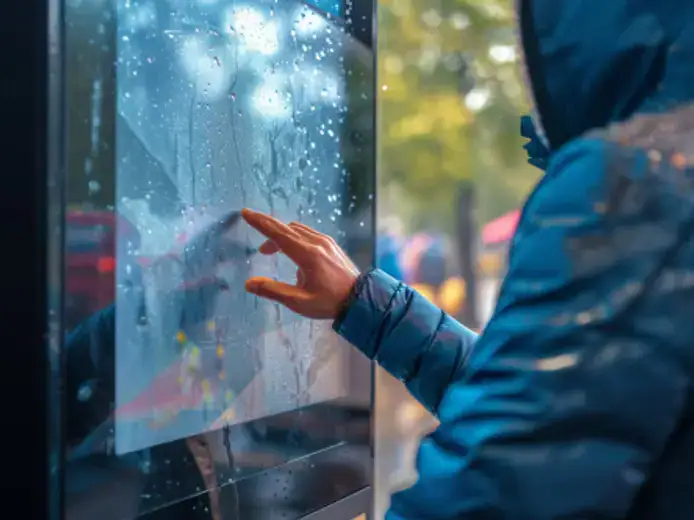




Projected capacitive (PCAP) touch is the technology behind almost every modern touch screen, from smartphones to industrial HMIs. Here is how a PCAP touch panel senses a finger, how its layers are stacked, and how it is made.
How a PCAP touch panel works
Think of a touch panel as a grid. One layer carries transparent conductive lines running in one direction, and a second layer carries lines running perpendicular to them. Laminated together, the two layers form a grid of intersections.
The touch controller creates an electromagnetic field at each intersection, and that field projects up through the cover glass. When a finger touches the glass, it absorbs a small amount of the field and changes the capacitance between the lines at that point. The controller measures the change and reports where the user is touching.
Mutual capacitance vs. self capacitance
- Mutual capacitance uses conductors separated in the z-axis. It is generally the most robust, highest-performance PCAP technology, with many controller IC and pattern options. It costs more because it needs two conductive layers.
- Self capacitance uses conductors on a single layer. It is the lowest-cost design and has inherent water rejection, but accuracy is typically poorer (3 to 4 mm errors) and it is usually limited to single touch and simple gestures. Advanced self-capacitance designs add multi-touch and better accuracy but are harder to make at high yield.
Common PCAP stack-ups
Sensor structures are named by layer. The first G is the cover glass; the remaining letters describe the sensor.
- GG / DITO glass: X and Y electrodes on glass.
- OGS (one-glass solution): the sensor is patterned directly on the cover glass, usually as a single-sided (SITO) pattern with insulating bridges.
- GFF: cover glass plus two patterned films, one for each axis. A widely used structure.
- G1F and GF1: single-film designs, with electrodes split between glass and film or on one film.
ITO glass vs. ITO film
The transparent conductor is usually ITO, sputtered onto glass or plastic film (typically PET). Glass tolerates the high temperatures of sputtering (over 300°C) and reaches a much lower surface resistance (about 10 to 20 Ω/sq versus over 140 Ω/sq for film), with less visible patterns and more durable ITO. Film is thinner and lighter. Both can reach good transmittance, although the extra adhesive layer in a GFF stack adds a little haze.
How a GFF touch panel is made
- First axis: a sheet of transparent conductive film is cut from a roll and annealed, a protective mask is printed and baked, the unmasked ITO is etched away, the mask is stripped and the sheet is rinsed, leaving one set of conductive lines. Silver ink traces are then printed to connect the lines to the flex circuit.
- Second axis: the same steps are repeated on a second sheet, with the lines running perpendicular.
- Lamination: optically clear adhesive (OCA) is laminated to each patterned layer, then the two layers are laminated together to form a sheet of touch sensors, which are die-punched out.
- Final assembly: the flex circuit (FPC, or COF with the controller chip on it) is bonded with anisotropic conductive film (ACF), the cover glass is laminated on top, and every panel is 100% inspected for optical defects.
Etching methods
Sensors are patterned by photolithography (highest precision, best for high volume, high equipment cost), chemical etching with printed silver traces (lower investment, coarser lines) or laser etching (dry and flexible for pattern changes, but slower).
Designing a touch panel for your product? See DCLTEK’s custom touch panels and display enhancements, or talk to an engineer.
DCL Technologies presents - How a PCAP Touch Panel is Made and Works.pdf Download PDF (854.31 KB)About DCL Technologies

DCL designs high quality display solutions that meet our clients’ overall objectives.
Our mission is to be the easiest display solution provider to do business with.
Our differentiator is a focus on delivering the best experience to our clients, at every desk. Our core value strategies are focused on making it easy for Engineers, Designers and Purchasing to get things done.
Contact:
Andrew Blum
DCL Technologies
800-407-8917
ablum@dcltek.com
www.dcltek.com